
Metropolitan Playhouse
The American Legacy
The American Legacy
"Theatrical
archaeologist extraordinaire" - - Back Stage

Follow us....


|
Metropolitan Playhouse
The American Legacy "Theatrical
archaeologist extraordinaire" - - Back Stage
|
Follow us.... |
|||||||
| Playing | Next | Season | Tickets | Company | Location | Mission | History | Links |
|
| Both
Your Houses |
Revisiting
The Hoover Dam (The Economist) |
|
|
|
| Of the People, By
the People “I am hurt.
A plague o' both your houses! I am sped.” -Mercutio, Romeo and Juliet, III There's something downright un-American about
doubting the value of democracy…but it was not the
dream of the nation's founders. Rather, the
Constitution assures that our government is not
a pure democracy, but a representative one. As
you'll recall, Publius (James Madison) explains why in
Federalist No. 10: pure democracy, by promoting
the will of the majority, quashes the rights of the
minority: "A common passion or interest will be felt
by a majority, and there is nothing to check the
inducements to sacrifice the weaker party. Hence it
is, that democracies have ever been found incompatible
with personal security or the rights of property; and
have, in general, been as short in their lives as they
have been violent in their deaths."
And so we have Congress. The Tea Party and the
President are hardly the first to be frustrated with
the workings of that august body, whose approval
rating in a recent Gallup poll was 10%. In 1933, in
the depths of the Depression, Maxwell Anderson took
dead aim at the gentlemen (and women) of the House to
show how even the most honorable and idealistic were
inevitably corrupted by a system that runs on graft,
gambling, and influence peddling without regard for
either the national interest or a sense of fair
play. In Anderson's incisive and ironic
portrayal, it would be unethical not to be unethical.
Bridge to Nowhere When Alan McClean, freshman representative from
Nevada, joins the House Appropriations committee, his
first order of business is to challenge a bill to
build a dam in his own district. Even though his own
constituency stands to gain, he knows that, at $40
million ($694 million in today's dollars), its cost is
too high. So he is shocked (shocked!) to find that
committee negotiations, instead of lowering the
expense, attach earmarks to run the cost up to $200
million ($3.47 billion, today.) Our hero, committed to
reform, and armed with a secret that gives him
powerful leverage with his new colleagues, takes a new
tack: he can freight the bill with so much pork it
will sink under the load and expose the whole corrupt
system. But the DC novice is not ready for
consequences he invites, neither the political nor the
personal. This fast-paced political satire was a West
Wing of the 1930's and hits just as close to
home in this election year.
The play takes flight on stage thanks to
Anderson's biting wit and recognizable but novel
characters. He evokes a Congressional committee
debate with the snap and crackle of backroom poker
game. A fiercely intelligent and lyrical writer, most
famous for his verse plays, his version of Washington
patois is both inspired writing and one-liner
funny. The committee given his words includes a
slick hustler, a curmudgeonly wit, a patient but
compromised sage, a tireless suffragette, and a
handful of workaday opportunists. When McClean
confronts this claque, the result is stage delight: an
ironic comedy filled with sincere outrage.
But what makes the play penetrate is what underlies the satire: Anderson's touching humanity. He presents a very funny but very real quandary, and when the stakes are no longer one man's principles but another man's life, the messy business of government by the people is brought out of the theoretical and into the heart. And yet, sentiment cannot rule the day in service to the public, can it? When, in the course... The play's inspiration was the construction of the Boulder Dam (you'll know it under its new hame: Hoover.) An ambitious and contentious project, the dam arrested national attention from its inception in 1931 to its completion in 1935. By opening night, Hoover was out, and the formerly Republican house had gone decisively Democratic, but Anderson is neither overly topical, regional, nor even obviously partisan. The party allegiances of the characters are never given and the president is a distant figure. It is the process that is the brunt of the joke. Today, amidst vigorous debate over the Federal government's role in supporting or strangling the economy; an earmark "ban" impeding, but not stopping, regional appropriations; and the public good itself a matter of debate, Both Your Houses is hardly an historical curiosity. When McClean utters his final warning: “It takes about a hundred years to tire this country of trickery—and we're fifty years overdue right now,” the challenge he throws down resonates deeply…80 years farther past his expiration date. Metropolitan's 21st season is devoted to "The American Dream", and we are delighted to begin with a play that interrogates one of its founding institutions.
- Alex Roe
|
|
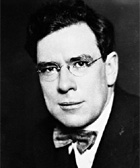
James Maxwell Anderson (1888 - 1959), born in Northwest Pennsylvania, took his BA in English Literature at University of North Dakota and an M.A. in English from Stanford. Until 1924, he worked variously as a high school and college teacher, and as a journalist for both local papers and national publications, including The New Republic. The
run of his first play, in verse, White
Desert (1923) was short lived, but
it caught the attention of critic Laurence Stallings, and
the two collaborated on1924's prose comedy What Price
Glory? This cynically unromantic
picture of soldiers in WWI launched Anderson's
extremely successful career in writing plays
of literary merit and social consciousness.
His next was the popular disection of a
marriage, Saturday's Children (1927).
He returned to verse with successful
historical dramas Elizabeth the Queen (1930)
andMary of Scotland (1933), and
then in Winterset (1935),
inspired by the Sacco and Vanzetti trials,
and High Tor (1936), about a
battle over quarrying on the Hudson River
palisades, both of which earned him New York
Drama Critics Circle Awards. Other works
include Knickerbocker Holiday (1938
with Kurt Weill), satirizing FDR and his New
Deal legislation; Key Largo(1939); The
Eve of St. Mark (1942); Joan
of Lorraine (1946); Anne of
the Thousand Days (1948); Lost
in the Stars (1949 - scored by
Weill); and The Bad Seed (1954)
adapted from William March's novel.
Additionally, he adapted many works of his own
or others into successful screen plays,
including Death Takes a Holiday, All
Quiet on the Western Front, and Joan
of Arc (with Ingrid Bergman). |
|
 |
 |
|