Melodrama in the theater has come
to be a dirty word but it was the staple of
the American theater until the advent of
realism and the plays of Eugene O’Neill.
Metropolitan Playhouse whose mission is
exploring plays of the American theatrical
heritage has rediscovered a smash hit from
1903 From
Rags to Riches by Charles A. Taylor, known as
the “The Master of Melodrama.” From Rags to Riches, written for the author’s then
wife, later the legendary Laurette Taylor who
made her New York debut in the leading role,
is great fun because of the intricate
plotting, the outrageous contrivances, and
Alex Roe’s delightful production.
The
Metropolitan Playhouse’s 20th season is
devoted to “Class” and From Rags to Riches delineates two classes in
American society: the haves and the have nots.
Money and its use is the underlying theme of
the play, and in that it seems extremely
modern. It depicts a turn-of-the-century New
York in which some are very rich and above the
law, while the rest are poor and automatically
suspect. On that level, it is a parallel for
our culture today where money talks and
wealthy crooks get off lightly while the
disenfranchised languish in their poverty as
well as find themselves without resources
before the law. And those who spend
extravagantly are seen as celebrity heroes and
trendsetters, even when they come to a bad
end.
From Rags to
Riches
is a classic melodrama in that it includes all
of the required elements of the genre: damsels
in distress, nefarious villains who appear to
be virtuous, asides to the audience, multiple
coincidences, attempts at violent crimes,
large emotions, characters in disguise,
emphasis on physical action, sudden reversals
of fortune, and a happy ending for all the
good characters and a bad end for the
evildoers. This play, however, is also much
neater than such plays usually are.
Each of the play’s seven scenes
ends with the requisite cliffhanger, but the
play is very well crafted with no loose ends.
Taylor appears to have known of Ibsen and the
well-made play formula while at the same time
exploding the rules of the by then
old-fashioned Victorian melodrama. The
characters may be stock types but they are
fully developed and all of the main characters
put in an appearance in each act. This is
unlike the construction of many traditional
melodramas in which characters reappear only
as plot devices for the author.
Much of the play depends on the
back story which is laid out in the first
scene. Fourteen years earlier, evil gambler
Prince Charlie, nephew and heir to old
Montgomery, had framed Albert Cooper in order
to seduce his wife Gertrude, who then lost her
two children. Just as Albert is let out of
prison, Charlie meets and lusts after Flossie,
the counter girl at the coffee stand run by
Mother Murphy, who has adopted the orphaned
girl and her younger brother Ned.
Meanwhile, Prince Charlie is
living in an unmarried state at his uncle’s
house with the gold-digging Flora pretending
to be Cooper’s wife to whom Charlie claims to
be making amends. Unknown to Charlie, his
uncle’s nurse who wears dark glasses is the
missing Gertrude, and Flossie is the lost
daughter that she seeks.
The plot is put in action when
Flora and Charlie attempt to poison his uncle
in order to inherit his estate. Flossie’s
plucky brother, known as Ned Nimble the
newspaper boy, comes to the rescue as Prince
Charlie attempts to kidnap his sister and take
her out of the country on his ill-gotten
gains, while Mother Murphy is taken in by
Charlie’s elegant manners and practically
throws the impressionable Flossie at him.
Aside from his impeccable casting
and understated direction, Roe is also
responsible for setting the beginning of each
scene to original music which establishes a
mood of Victorian music hall. In addition, he
is responsible for the simple but effective
sets which allow for quick changes from a
street on the Bowery, to a mansion on
Manhattan’s West Side, the roof of the Waldorf
Hotel, a basement dive, and an estate on the
Hudson. Sidney Fortner’s many costumes are
redolent of the period as well as attractive
in their own right. Flora’s gowns are
particularly stunning.
Erin Leigh Schmoyer and Tod Mason
make excellent adversaries as Flossie and
Prince Charlie. Schmoyer’s disarming Flossie
is the uncultured girl brought up on the
streets who will do almost anything for money
– but within moral limits. Mason’s Charlie is
the suave villain who does not twirl a
mustache but is much more insidious in his
evil doing. As Flossie’s resourceful brother
Ned, Paul Bomba deals heroically with the
worst of Prince Charlie’s malevolent schemes
and much of the physical exploits. Carol
Lambert’s cheerful laidback Irish charm as
Mother Murphy contrasts with Ingrid Saxon’s
intense and impassioned Gertrude.
Claire Warden, on the other hand,
gives an elegant, drawing room portrayal of
the mercenary Flora, looking and sounding a
great deal like the young Diana Rigg. Ralph
Petrarca is convincing as the alcoholic Albert
Cooper, as well as responsible for the deft
arrangements and live accompaniment to the
songs before each scene. Straight out of a
turn-of-the-last century penny dreadful but no
longer to be seen in movies or plays, Erwin
Falcon is amusing as the evil Chinese Sam.
Peter Judd and Richard Cottrell give able
assistance as old Montgomery and retired
Police Detective Brown incognito,
respectively. Josh Gulotta and V. Orion
Delwaterman demonstrate their versatility
playing ten roles between them.
Metropolitan Playhouse has found a
winner in the forgotten From Rags to Riches by Charles A. Taylor. From the
polished direction of Alex Roe, to the
admirable stylishness of the 13 member cast,
to the appealing visual design and musical
interludes, this is an excellent introduction
to theater before realism. The Age of
Melodrama may be dead and buried, but you
would never know it from this 108 year old
play which turns out to be great fun in our
century.
Melodrama Returns,
Flaunting Its Chaos and Clichés
By Ken
Jaworoski ; September 26, 2011
According to the
Metropolitan Playhouse “From Rags to Riches” has not
been revived in New York for more than 100 years.
After seeing the play you’ll wonder if the last troupe
to stage it has yet recovered from the experience. A
sprawling tale assembled from dozens of styles, genres
and plots, the show is by turns slapdash, bewildering,
rousing and ridiculous. It’s also more appealing than
it has any right to be.
“From Rags to Riches,” first performed in 1903, was
written by the “Master of Melodrama,” Charles A.
Taylor, who in 1892 had five plays running at once in
New York. Parts comedy, drama and thriller, “Rags”
centers on an impoverished brother and sister who will
soon inherit a fortune. They are thwarted by a Snidely
Whiplash-type scoundrel, his scheming partner and an
opium dealer, and simultaneously pursued by their
long-lost parents, who hope to re-establish the
family.
In addition to the fanciful plot the play features
many hallmarks of the time. Exposition-filled asides
are delivered directly to the audience as others in
the scene look on, oblivious; and one character simply
dons glasses to disguise herself. The show was likely
intended for spacious theaters where big gestures were
prized and nuance was nonexistent. So much seems
written and delivered in capital letters. Then
underlined. Twice.
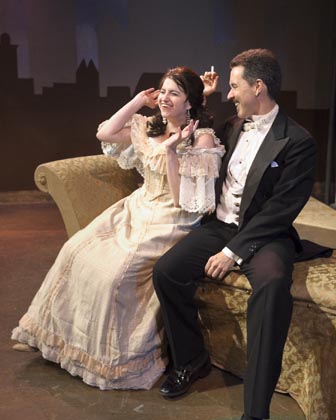
Erin Leigh
Schmoyer*, Tod Mason*. Photo by Jacob J. Goldberg.
On the tiny Metropolitan stage this can come off as
even more ham-handed. Lines like “Mother and I battle
the world day and night to support our home in
poverty. But if we are compelled to purchase riches at
the cost of my sister’s honor, we’ll remain in rags
all the rest of our lives” don’t exactly roll off the
tongue. And that’s before the murder plot, the
kidnapping, the chases and the onstage death. It would
be entirely unsurprising if, in the middle of any
scene, the villain tied the heroine to a set of
railroad tracks and twirled his mustache as a speeding
train approached.
Still, those are observations of the script, not
criticisms of the production, which is unquestionably
impressive. Though a few of the 13 cast members get
lost in the commotion, most handle their work well.
Paul Bomba and Erin Leigh Schmoyer as the brother and
sister, and Ralph Petrarca as their father, are
especially skillful. Alex Roe’s direction and Sidney
Fortner’s costumes are praiseworthy.
Metropolitan Playhouse, which revisits works “that
explore the American theatrical heritage,” has made an
audacious choice, allowing viewers to ponder how
theater has evolved and how status was portrayed.
(“Class” is its theme this season.) At 2 hours 15
minutes, even those eager to see this forgotten work
may tire. Yet since it is so rarely produced, this may
be their only chance. There’s no question that “From
Rags to Riches” is sort of a mess. But it can also be
sort of fun.
By Erik Haagensen ; September 23, 2011
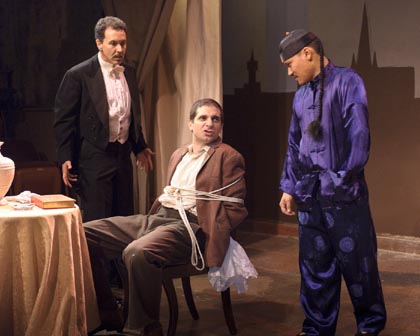
Tod
Mason*, Paul Bomba*, Erwin Falcon*. Photo by Jacob J.
Goldberg.
The 2011 Obie Award–winning
Metropolitan Playhouse's 20th season is devoted to
exploring the issue of class in America, that
supposedly classless society. Kicking it off is
artistic director Alex Roe's kicky production of
Charles A. Taylor's "From Rags to Riches," a 1903
Broadway melodrama he wrote for his then-wife, the
19-year-old Laurette Taylor, launching her long stage
career. The Taylors' vehicle is very much a commercial
artifact of its day and a compendium of all the
clichés that implies. It doesn't explore the
issue of class so much as display it. Nevertheless,
Roe's impish direction and a strong cast of 13 make
the evening's two hours and 20 minutes fly by in a
breeze of entertainment.
Our hero
and heroine are teenagers Ned Nimble, a humble newsboy,
and his older sister, Flossie, a counter girl at the
lunch stand owned by the redoubtable Mother Murphy, the
unofficial guardian of these two abandoned children. Ned
is determined to find their lost mother, who gave them
away as babes to take up with the suave but evil Prince
Charlie, who, unbeknownst to her, framed her husband,
Albert, for a crime that Charlie committed. The sexually
voracious Charlie soon dumped her and moved on to a
succession of greener pastures. Seeing the error of her
ways, she assumed the pseudonym Gertrude Clark and went
to work as a private nurse to Old Montgomery, a rich
tycoon whose sole heir is his nephew, who just happens
to be Charlie. Also in the mix are Flora Bradley, a
former actor who is posing as Charlie's English wife to
give him a veneer of respectability in his uncle's eyes,
and the vicious Chinese Sam, a "dog doctor" whose
offices are near Mother Murphy's stand.
The plot begins as Albert leaves prison and Charlie
accidentally meets and develops a yen for Flossie,
though unaware of who she really is. The incident-packed
tale has all the standard melodramatic flourishes:
lightning reversals of fortune, kidnappings, gun
battles, impossible coincidences, endangered virginity,
noble appeals to religion, freighted asides, and of
course a happy ending. It's a show in which the villain
actually says things like "I have you in my power" and
"Bah!" and identity can be concealed behind a pair of
dark glasses. Roe's smart and sly helming both honors
and sends up the material, and while some comic rhythms
had yet to fall into place at the show's third preview,
I have no doubt the bumps will quickly be ironed out.
Roe has also added a surprisingly effective conceit of
having the characters sing the opening and closing lines
of some scenes (and has written his own music to boot).
These moments locate the honest emotion that audiences
of the day would have found in the material, giving the
show sweetness and heart.
It's easy to see how the perpetually cheerful and
relentlessly naive Flossie could have been a star-making
role, and snappy Erin Leigh Schmoyer goes straight for
the goods in a thoroughly winning turn. Paul Bomba is an
excellent Ned, wisely underplaying the character's
strident morality while giving off a whiff of street
tough in a performance eerily reminiscent of the young
Martin Scorsese. Tod Mason is persuasively smooth and
menacingly effete as the dastardly Charlie, while the
commanding Claire Warden is brisk, bad, and very funny
as Flora, his faux spouse. Everybody contributes good
work, but other standouts include Carol Lambert's spunky
Mother Murphy, Peter Judd's crusty Old Montgomery,
Ingrid Saxon's wide-eyed Gertrude, and Erwin Falcon's
raucous, political-correctness-be-damned Chinese Sam.
"From Rags to Riches" is not as interesting or resonant
as some of the other plays Roe has unearthed, and its
blatant anti-Chinese bigotry strikes some sour notes.
But if you are in the market for a loving and
intelligent evocation of a once-classic American art
form, then hie thee to Metropolitan Playhouse.
Presented by and at Metropolitan Playhouse, 220 E.
Fourth St., 2nd floor, NYC. Sept. 23–Oct. 16.
Wed.–Sat., 8 p.m.; Sun., 3 p.m. (Additional
performance Sat., Oct. 15, 3 p.m.) (212) 995-5302 or
www.metropolitanplayhouse.org.
CurtainUp
By Deirdre Donovan ; based on press performance
of September 22, 2011
That brazen hussy in the silk petticoat . Look at
her with the airs of a lady and the jewels of a
Dutch heiress. — Mother Murphy
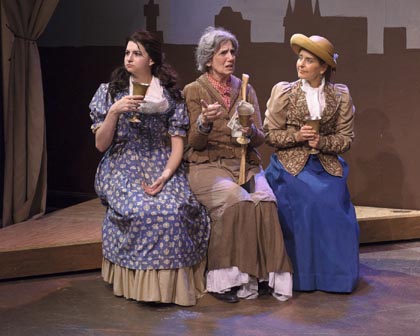
Erin Leigh Schmoyer*, Carol Lambert*, Ingrid
Saxon*. Photo by Jacob J. Goldberg.
Charles Taylor’s melodrama
From Rags to Riches has just pitched camp at the
Metropolitan Playhouse in the East Village. Ever since its
first appearance in 1903, it has been widely viewed as the
gold standard of the genre. And Alex Roe’s fun to watch
revival reminds you why melodrama reigned over American
theater in the mid-19th century.
The title neatly sums up the story: The heroes go from
rags to riches. But beyond the surface plot, From Rags
to Richers offers a fascinating critique of American
wealth, and shows us the ripples of perversions in the
idle rich; for example a philanthropist called Old
Montgomery (Peter Judd) who bestows wealth on the worthy
poor, but also has a morphine addiction that makes him
quite dim-witted. Worse, he dies (or is he murdered?)
early on from an aneurysm.
What keeps the show afloat is its blend of silky villainy,
gritty heroism, and some blithely catchy tunes (original
music by Alex Roe) played on the piano by the gifted Ralph
Petrarca. The production demonstrates the split
personality of melodrama, or to borrow from the program
notes, “its constituent parts are “melos” (music) and
“drame” (drama).”
Tod Mason's gambler Prince Charlie positively oozing with
unsatisfied greed and dandified vanity. Erin Leigh
Schmoyer's Lolita-like Flossie, hits all the hot-button
issues of upward mobility. Paul Bomba's newsboy Nimble Ned
is pluck personified. Carol Lambert as Mother Murphy is a
fireball of energy and Ralph Petrarca is laudable as the
ex-convict Albert Cooper. Erwin Falcon and Ingrid Saxon
are convincing in their minor roles of Chinese Sam and
Gertrude Clark. Rounding out the ensemble are Claire
Warden as the “adventuress” Flora Bradley, Richard
Cottrell as the valet Brown, Danny Makali’i Mittermeyer as
Police Officer Mike Dooley, and Peter Judd as Old
Montgomery.
Though the characters are more types than fully-realized
dramatic figures, this old-fashioned melodrama
nevertheless poses some questions that still resonate: How
does one deal with the harsh realities of a
class-conscious society? Why does money so often
contaminate people and situations? Indeed this show takes
place at the juncture of “class” and “money.” It sharply
dramatizes what happens in the Bowery when the upper-crust
meets the lower, and sins are very much what they used to
be. We witness murder, abduction, rape, a detour into a
Chinatown opium den, and a surprising eleventh-hour
turnaround that shifts the action to a posh room at the
Waldorf-Astoria.
Admittedly, there are times when the play goes way over
the top and turns into slapstick; for example, a literally
smashing scene in Act 2 that has Nimble Ned executing a
Herculean feat to rescue his sister Flossie. And though it
represents the play's peak moment and is ingeniously
staged, it also makes you understand why 19th-century
melodramas went out of fashion.
From Rags to Riches is dated in its style, but
under Alex Roe’s intelligent direction, this old saga
about economic stagnation is right on the money.






 The 2011 Obie Award–winning
Metropolitan Playhouse's 20th season is devoted to
exploring the issue of class in America, that
supposedly classless society. Kicking it off is
artistic director Alex Roe's kicky production of
Charles A. Taylor's "From Rags to Riches," a 1903
Broadway melodrama he wrote for his then-wife, the
19-year-old Laurette Taylor, launching her long stage
career. The Taylors' vehicle is very much a commercial
artifact of its day and a compendium of all the
clichés that implies. It doesn't explore the
issue of class so much as display it. Nevertheless,
Roe's impish direction and a strong cast of 13 make
the evening's two hours and 20 minutes fly by in a
breeze of entertainment.
The 2011 Obie Award–winning
Metropolitan Playhouse's 20th season is devoted to
exploring the issue of class in America, that
supposedly classless society. Kicking it off is
artistic director Alex Roe's kicky production of
Charles A. Taylor's "From Rags to Riches," a 1903
Broadway melodrama he wrote for his then-wife, the
19-year-old Laurette Taylor, launching her long stage
career. The Taylors' vehicle is very much a commercial
artifact of its day and a compendium of all the
clichés that implies. It doesn't explore the
issue of class so much as display it. Nevertheless,
Roe's impish direction and a strong cast of 13 make
the evening's two hours and 20 minutes fly by in a
breeze of entertainment.