NORA:
[sits down on bed and tries to turn him towards her]
Joe, my darling, listen to me. NORA:
[sits down on bed and tries to turn him towards her]
Joe, my darling, listen to me.
You've been a wonderful boy, and I love you as very
few people have ever been loved in this world.
Because I had lost everything, you see, when I found
you, everything. I had thrown everything away.
And you've had to be the whole world for me since.
The whole world, you see.
There isn't anything else.
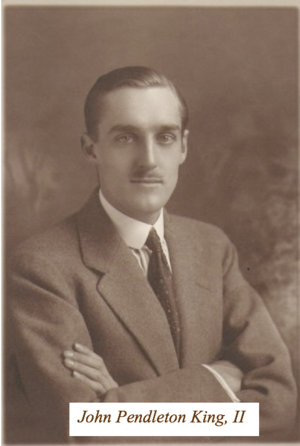
Pendleton King (1889 - 1919)
Pictures in this
section:
Portrait of the Artist
Portrait
of the Artist as a very young man, 7 years old,
Lindsey's Art Parlors 1897. UNT University
Linbraries
Postcard Oriel College, circa 1905
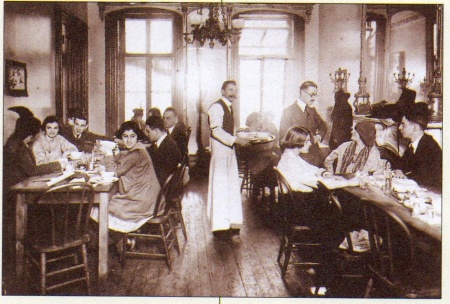
Polly Holladay's restaurant circa 1915, home of the
Heterodoxy Club and of The Liberal Club
Cartoon accompanying "When Players at the Bandbox
Really Play," A. Briggs, NY Tribune, Dec. 5, 1915
List of draftees, NY Sun, May 9, 1917
Photo from article, Lieutenant J. Pendleton King to the
left, Frank P. Sibley to the right, reporter,The Boston
Globe, June 14, 1919
The cover of "Rookie Rhymes."
The Sunken Blue
Garden, created by Pendleton King, who loved blue plants
and flowers, and created the garden
[Ed. Note:
Except for the six months King worked in New York, Nov.
1916 through April 1917, his life was lead in
relative privacy. Without the internet it would
have been onerous to pull together a biography of any
substance. And, to the best of our knowledge, in
over a hundred years, nobody did. We offer below
more personal detail and samples of his other writing
than is usual in the Metropolitan Playhouse
essays, as befits an artist and a most curious
fellow, forgotten since the premiere of his signature
work. There is more background to be shared, and
it will be added and more fully "citated" in weeks to
come.]
Early Life and Education
John Pendleton King II was born on July 9, 1889, into a
wealthy aristocratic Southern family. Pendleton was the only son of Henry
Barclay King (1844 - 1931) of Augusta, Georgia. H.
B. was a director in the banking and cotton manufacturing
companies presided over by his father, the
patriarch of the family, John Pendleton
King I (1799 - 1888). The first John Pendleton
King was an attorney, judge, Georgia U.S.
Senator, plantation owner, banker and railroad
builder. At sixteen, with money and a horse given him
by his father, he set out for Columbia County,
Georgia, to visit an uncle. He was sponsored
to an education in law and went onto amass large
plantation holdings by 1860 and associated manufacturing
and railroad operations which sustained him after his
support of the Confederacy cost him three million dollars
in losses.
Known as “Pendleton,” our playwright grew up on the
family’s estate, called Sand Hill, in Augusta, GA.
He was well-educated as befitted landed Southern gentry,
attending Richmond
Academy, 1902-5, as did his namesake, and then
Sewanee, "The University of the South," 1907-1909 where he
was member of the Dramatic Club.
 In April 1909, the Sewanee
Players produced London Assurance, "the well
known English play" which "made a big hit in
Memphis and Shelbyville." The parts are all
portrayed by college men and Pendleton played 'Lady
Gay Spanker'. In April 1909, the Sewanee
Players produced London Assurance, "the well
known English play" which "made a big hit in
Memphis and Shelbyville." The parts are all
portrayed by college men and Pendleton played 'Lady
Gay Spanker'.
In a write-up the next day in the Nashville Banner,
he received what was perhaps his first rave review:
"... easily the hit of the play. The role was
taken by Mr. Pendleton King, who can claim high rank as
a female impersonator. His make-up was splendid,
and his reading, under the handicap of masculinity, was
decidedly good. His every exit was the signal for
applause and he was forced to bow his thanks at the
conclusion of the third act."
He attended Oriel College, Oxford University,
1909-1913, living in the same rooms his father had
when he had attended Oxford. Among his Oxford
acquaintances was the flamboyant Prince Felip Yusupoff,
who allegedly conspired in the assassination of Rasputin,
about whom Pendleton later wrote for the New York Times. (New
York Times, Sunday Magazine, January 14, 1917:
Prince Yusupoff Defended in Rasputin Case;
Fellow-Collegian at Oxford Tells of Nobleman's Career
There, and Says It Is Impossible to Associate Him with a
Murder). It is written with great polish and
breeziness, in 1917, in contrast to his demi-monde Cocaine,
which was to play later that year at the Provincetown
Playhouse:
"One of the things I remember most vividly about him
[The Prince] was his unbounded admiration for and
adoration of his mother. They used to correspond
with pages of cablegrams every day. I remember I
expostulated with him one day on the extravagance of it,
but he said: "No, you see, she wants to know exactly how
I am today - not two days ago." And then he told me a
strange story. A fortune teller once predicted the sons
of Prince Yusupoff would be killed in duels when they
reach the age of 26. His elder brother had been
killed in a duel at the age of 26. And Felix was
then in his twenty-sixth year. Perhaps that was
one reason he was sent to college in England, where they
don't fight duels."

Through his Oxford years, he would transit between the
family summer estate is Asheville, NC, winter holidays on
their property in Augusta, GA and the months
between, in England and the continent. He made the
rounds of Southern society, as guest throughout the season
at the weddings, the dinners, the dances, the annual
Cotillions, horse shows, golfing, games of 'progressive whist', seaside
respits and mountain retreats.
Social Season and Amateur
Theatricals
After his graduation from Oxford, in 1913, among the
'dinners in honor of ' and the 'weekends chaperoned by,'
we start to see notes of theatrical events produced,
performed and written by Pendleton King. He
started exhibition dancing the maurice tango and the
castle walk and he put together evenings of comedy,
created Circus act in a "Society Vaudeville," gave piano
concerts and found occasions to present original
sketches and monologues. For example, from
August, 1913, a tongue-in-cheek press release written
himself:
The play to be given this evening in the
Manor ball room by Pendleton King and a number of the
others of the talented young country club set is
entitled "The Divorce Bureau" and gives every evidence
of being a most amusing little comedy. The hand
bills for the play offer the following
inducements. "One of the Greatest Plays of
Future Times. Real cigarettes smoked on the
stage. No moral. Simply teeming with local
talent. One night only ... Peanuts will be
confiscated." The star on this occasion is as
yet unknown, as is also the author of the play,
although it is rumored that this last person is pretty
generally suspected of being a popular young member of
the country club ... That the play is a clever piece
of work suggesting here and there gay scenes of ultra
fashionable life is a known fact ... a satire on
society or equally well a "Critique on
Climbing." Many touches of color from English
society life will be introduced by Mr. King, the
popular young Oxford graduate who is spending the
season here ... and will take the role of "Lord
Reginald Venning."
In June 1914, an engagement is hinted at in a local
paper. In August, 1914, the announcement, in the
authoritative Atlanta Constitution, of the engagement of
Miss Mary Lou Phinizy and Pendleton King is "one of
broad social interest throughout Southern society, and
the marriage will unite through two popular young people
two of Georgia's notably prominent families."
Miss Mary Lou was in Europe at the time of the
announcement. Mr. King was visiting her parents in
Asheville. There was no date set though it was
indicated that it would be some time that fall, upon Miss
Mary Lou's return from Europe. There is noting
further on the engagement until December, 1914, when the
Asheville Gazeette-News reminds the social set that Miss
Mary Lou Phinizy has indeed returned from Europe, and her
engagement to King was announced during the summer.
In January, 1915, Pendleton announces he's leaving
for New York.
P.S. Miss Mary Lou Phinizy died in 1977 never having
married.
New
York City
From the editor of his hometown paper, the
Augusta Chronicle, a letter of introduction:
Mr. Pendleton King has decided to tackle New York
newspaperdom and to leave in a few days to
launch in the calling in that city.
Mr. King is gifted with the pen. He writes
charmingly and in a most captivating strain.
I have seen some of his unpublished work of which
any of us in the newspaper press would be proud to
be able to produce. Personally, Mr. King is a
capital gentleman; cordial, considerate, kindly -
a man who makes friends and deserves them.
For him in the city of boasted newspaper
enterprise and loudly acclaimed perfection in all
things journalistic, his well-wishers in Augusta
bespeak for Mr. King the best of success.
Pendleton had no
obvious work on a newspaper for
awhile. But he certainly continued his
rounds of dinners and weekends, with a
circle of new friends scaled up from the
monied society of Georgia to an
international band of successful writers,
actors, well-regarded progressives, and the
accomplished scions of the extraordinarily
rich.
He was aided and abetted in
his efforts by his
aunt, the
"Marchioness of
Anglesley." Mary
"Minna"
Livingston King
(1842-1931), his
father's sister,
who was briefly
married to an
English peer,
the 4th Marquis
of Anglesey,
lived in Paris,
and had
befriended
Pendleton during
his Oxford
years. She
knew everyone
from Queen
Victoria to many
New York society
and cultural
figures,
including some
MacDougal Street
scalliwags.
A
few weeks after heading
north, on February 15,
1915, Anne Morgan, J.
P.'s daughter (and a friend
of the Marchioness) hosted
Pendleton at her Adirondak
Camp to meet Ida
Tarbell, the
renown
'muck-raking'
journalist.
Ida Tarbell was friends with John Reed and
Lincoln Steffens, and was a direct
connection into the The Liberal Club and
MacDougal Street. There was a dinner,
at the Connecticut home of Nina Wilcox
Putnam, a very successful author and screen
writer, and a leading member of Heterodoxy,
on MacDougal Street. George
Middletown, a Broadway playwright and
Dramatist Guild pioneer for playwright's
rights, and his wife Fola la Follette, labor
organizer, suffragette and celebrated
actress, both members of the progressive
village community; later that year, off to
Palm Beach to visit the niece of Henry
Flagler, the head of Standard Oil, who
developed Palm Beach into a glamorous resort
for very rich Americans.
Throughout 1915 and 1916, he would
occasionally
visit Augusta
or Asheville
for a social
event or a
creative
project (such
as writing an
article for
the Augusta
Chronicle or
trying out
material in
performance at
a charity
event).
MacDougal Str eet and the
Players eet and the
Players
He made his way
to MacDougal
Street in
Greenwich
Village, where
it is noted
that he
participated
in play
readings at
the Liberal
Club (as noted
in "Harry
Kemp, the Last
Bohemian"),
the forebear of The Washington Square Players, perhaps in 1915
An
early connection
with the Players is documented (New York Tribune, dated
December 5, 1915) as Pendleton had apparently
accompanied the Washington Square Players in their
nightly celebration after a performance of Overtones
which ran from Oct 04, 1915 - May 20, 1916 at the
Bandbox Theatre on 57th St. He is named
in the rollicking story by Sarah Addington ("And
they jeered the poor girl about her funny dress
until she drew off into a corner with a kind-hearted gentleman,
Pendleton King ..."). I believe he is
caricatured in the illustration above to the left of
Helen Westley. And I believe that is Alice
Gerstenberg, author of Overtones to his
left.
Later that month he
was reported to have been performing "snatches of
verse and ragtime tunes" at Louie's, the
oft-raided basement bar along Washington Square South,
that notorious strip for carousing and pick-ups.
Louie Holladay who owned the establishment, was brother
to Polly, who ran a coffee shop on MacDougal Street,
next door to the first Provincetown Playhouse, where she
hosted The Liberal Club, where Pendleton would have met
many of the artists and radicals who were to become
Provincetown and Washington Square Players. Polly
also hosted the Heterodoxy, a political and sexually
diverse "luncheon club" of women that met every two
weeks.
In October 1916, he was seen with Washington
Square Players Henry Meltzer and Frank Conroy (who is in
the New York Trib illustration above), among Marcel
Duchamp, hula dancers and strategically clad gladiators
at one of the famous costume balls at Webster Hall, the
Studio 54 of its day.
He was reported as hosting his own bi-weekly soirees for
uptown society figures mixed with downtown Bohemians at
1 Milligan Place, (neighbor of Provincetown
Playhouse founds Susan Glaspell and Jig Cook at 3
Milligan Place). Among his guests, stock brokers,
journalists, architects, a Vanderbilt and the notorious
Mercedes Da Acosta would rub elbows with
Provincetown Players Ida Rauh and Rollo Peters,
Washington Square Players Phillip Moeller and Helen
Westley; Jack McGrath, fellow cabaret artist from
Louie's. "Goulash and mulled wine, the latter a
marvelous concoction of "red ink"plus many spices" and
the uptowners thought it was rare fun to carry their
own food in from the kitchen ... sans waiters."
In October 1916,
he was seen with Washington Square Players Henry
Meltzer and Frank Conroy, among hula dancers and
strategically clad gladiators at one of the
famous costume balls at Webster Hall, the Studio
54 of its day.
 He
was put to work in the fall of 1916 in the theatre
community of progressive Greenwich Village. He
appeared with the Washington Square Players, "The
Altruist," November 1916, and then aligned himself as
writer and actor with the Provincetown Players, "A Long
Time Ago," January, 1917; "The Dollar," January
1917; "Barbarians," February, 1917; "The People,"
March, 1917; He participated in a one night staging of
an anti-war play, "As It Was in the Beginning"
January 28, 1917 with the Stage Society of New York
at the Gaiety; his final appearance on the New
York stage was on April 22, 1917 in an evening of
one-acts with the Morningside Players: "The Home of
the Free"; "One a Day"; and "Markheim" at the Comedy
Theatre. As a writer, along with the
well-received production of Cocaine in March
1917, it was reported that he had begun work at the
New York Tribune. He
was put to work in the fall of 1916 in the theatre
community of progressive Greenwich Village. He
appeared with the Washington Square Players, "The
Altruist," November 1916, and then aligned himself as
writer and actor with the Provincetown Players, "A Long
Time Ago," January, 1917; "The Dollar," January
1917; "Barbarians," February, 1917; "The People,"
March, 1917; He participated in a one night staging of
an anti-war play, "As It Was in the Beginning"
January 28, 1917 with the Stage Society of New York
at the Gaiety; his final appearance on the New
York stage was on April 22, 1917 in an evening of
one-acts with the Morningside Players: "The Home of
the Free"; "One a Day"; and "Markheim" at the Comedy
Theatre. As a writer, along with the
well-received production of Cocaine in March
1917, it was reported that he had begun work at the
New York Tribune.
On May 9, he got his draft notice.
The 26th Division in
France
In April 1917, President
Woodrow Wilson went before Congress asking it to declare
war on Germany. Pendleton King was drafted
immediately. 
He left for the officers' training camp at the Plattsburgh
Training Camp, May 12, 1917.
Harper & Brothers published "Rookie
Rhymes: The men of the 1st and 2nd Provisional
Training Regiments in Plattsburgh, May 15 thru August
15, 1917" in September as the division shipped
out. A collection of poems, illustrations and
parodies by troops in training, drawn mostly from New
England (and the Ivy League). The New York
Times Book Review, Sept. 30, 1917, received it well with
a special mention of the amusing but macabre "Ballad of
Montmorency Gray," by Pendleton, about a brilliant
lunatic soldier who did everything perfectly and then
wandered away from camp, where he is found far far away:
"as meek and mild as a little child, he did not rave
or rant, he only cried, until he died: "You
ought to, but you can't!"

He received his commission of first
lieutenant in the infantry in early August, then off the
Cambridge, Massachusetts for training in trench
warfare. He sailed for France, Sept. 26, 1917.
He was subsequently promoted to Aide de Campe
to General Edwards, Division Staff. The promotion
had been conferred upon him because he was familiar with
English life and his spoke French fluently.
The 26th Division was the first division of the American
Expeditionary Force to be organized, the first to cross
the water as a division, and the first to take the
battle line as a division. They saw
significant action in battle and between the forays they
were able to organize entertainment.
Boston Globe correspondent
Frank P. Sibley (he is in the picture at the
above right, with Pendleton King) embedded with
Division 26, the "Yankee Division," and reported about its
role in the War. The articles are collected
and published as "With the Yankee Division in France (1919
Boston; Little, Brown & Co.)". He takes note of
Pendleton King:
In the back areas, we ... began to organize a minstrel
company. In a month it was going well ; it played continuously
for the
rest of the time we were in France, except during the
hottest of our actions. It came home with the Division,
and as soon as discharged went on the road by itself.
The performers were selected from all sorts of outfits,
the artillery supplying a fairly large number.
In every company and every battery in the Division
try-out shows were held ; the men who already
had had professional experience were chosen for the big
show, so far as possible, and were ordered back
to Division Headquarters. Rehearsals were held in a
barn, and a programme beginning with an old-fashioned
minstrel show, a vaudeville bill and a really
funny sketch of life in a military company was put
together...later ... lieutenant John
Pendleton King, a New York playwright, pianist of fine
ability, and a Georgian by birth — but a thorough Yankee
in spirit, — had the show in his care. He brought it
home, in fact.
And bring it home he did. March 23, 1919, stateside,
he oversaw the performance for U.S. Army general John J.
Pershing (1860-1948) commander of the American
Expeditionary Force (AEF) in Europe during World War I.:

Five acts were put on, lasting just an hour. General
Pershing registered every joke and apparently enjoyed
himself immensely. In fact, he remained seated
after the end, still applauding and afforded a
repetition of the final number. When the curtain
came down for the second time he assured Lieut. King
that it was the best division show he has ever seen ...
The thing had gone off neatly, smartly and to a complete
success.
In 1918, Pendleton
King was awarded the Croix de Guerre, a gift of the French
army, for distinguished service during the second battle
of the Marne. He returned home to Augusta on May 26,
1919
Pendleton King's
Death
https://www.pendletonkingpark.com/history
 From the website of
Pendleton King Park: After he had been home for
about three weeks, he heard screams coming from Lake
Elizabeth on the family property. He discovered
two women drowning; he managed to save one of the women,
but the other drowned. Shortly after the accident,
Pendleton became ill and during a violent paroxysm of
coughing, died of a probable brain aneurysm.
He was only 29 years old. His parents were
heartbroken. From the website of
Pendleton King Park: After he had been home for
about three weeks, he heard screams coming from Lake
Elizabeth on the family property. He discovered
two women drowning; he managed to save one of the women,
but the other drowned. Shortly after the accident,
Pendleton became ill and during a violent paroxysm of
coughing, died of a probable brain aneurysm.
He was only 29 years old. His parents were
heartbroken.
The episode on the lake was reported in some detail,
with discrepancies from the story above, in the Augusta
Chronicle, on May 28, 1919, in that five pupils of Paine
College were bathing at a pond on the homeplace of the
King family, one of them got out of her depth, began to
scream in terror and the others rushed in to save
her. Private M. Hamulas of Camp Hancock, was on
the grounds, hear d the screams and succeeded in
rescuing the drowning girl. However one of the
other pupils, Benita Stallwood, who had rushed in to
save the first girl, had gotten out of her depth at this
time, could not swim and drowned. Lieut.
Pendleton, only one day back from service, rushed in to
secure the body of the drowned girl. She was dead
when taken from the lake but nearly an hour was spent in
trying to resuscitate her.
The Atlanta Constitution, on May 28th cited the blood
poisoning (infection?) from a hand injury received in a
car accident caused a coughing spell that resulted in a
cerebral hemmorhage. No mention of the drowning
accident.
Did someone decide, perhaps his doting mother, that the
drowning accident was a far more noble cause of death
than a car accident?
In his will, the elder King designated in his will 64
acres as a park memorial to his son in perpetuity, now
known as Pendleton King Park. He also designated
15 acres a mile away for the use and benefit of World
War I veterans, which his son had been, and their
descendants. Pendleton King Park is a 64-acre bird
sanctuary of great topographic diversity with pine
forests, sand ridges and marshes. It houses a
variety of gardens and natural resources, as well as
recreational activities including new playgrounds, an
18-hole disc golf course, nature trails for walking and
cycling, waterfalls and wetlands, cross country trtails
and open spaces for picnicking and play. One feature of
the sanctuary, pictured to the right, the Sunken Blue
Gardens, was originally developed by Pendleton, who
wanted to create a garden which bloomed in blue, a more
unusual color for plantings.
One of the poems Pendleton wrote that was not included
in the Rookie Rhymes publication, Sept, 1917, was
published in his local paper and then widely reprinted.
It is an authentic expression a soldier's fears, and it
is more chilling that it presages his own death, using
an image of a river as the metaphor for end of the
road.

Cocaine and The Provincetown
Players
https://www.google.com/books/edition/Cocaine/pbgEAQAAIAAJ?hl=en&gbpv=1&dq=inauthor:%22Pendleton+King%22&printsec=frontcover
Pictures below:
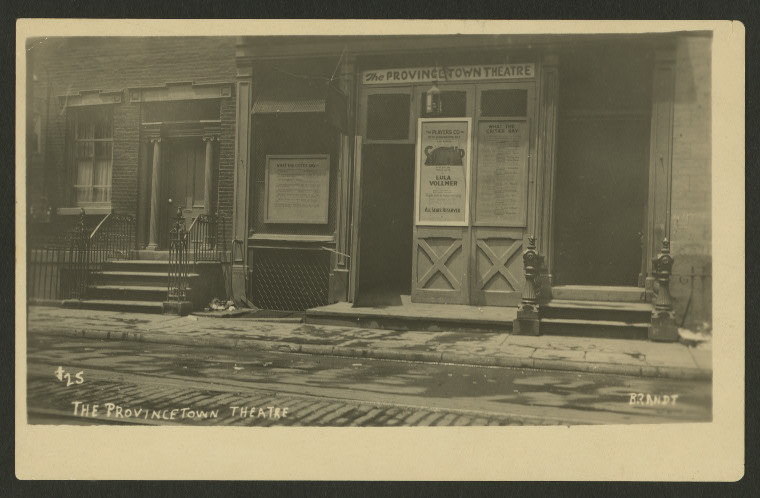
133 MacDougal, first New York location
of The Provincetown Playhouse
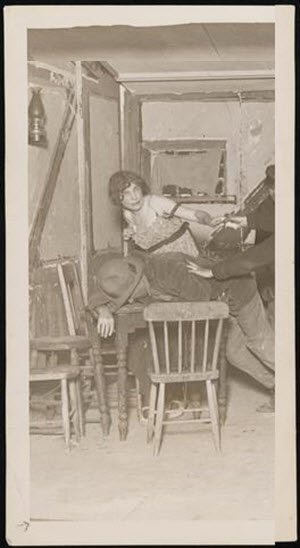
Ida Rauh, who was the original
Nora, is pictured here in another
Provincetown Players production
Eugene Lincoln, the original Joe,
pictured here in "In the Zone" at the
Washington Square Players
 Cocaine
was the surprise hit of the Provincetown Players first New
York season (1916-17), the first and only play the Players
performed by Pendleton King, but a play for which they had
much affection. Cocaine was read to
the Provincetown Players, one assumes by King, at the
November 22 meeting and was voted on at the December 3
meeting, “saved from rejection at this time only by the
absentee votes of the Hapgoods.” The play was
not scheduled until March 1917’s Eighth Bill, but King
began to perform as an actor with the Players. The
play was performed March 9 thru 14th, 1917. And
again presented later that month, March 30 thru
April 4. There was note included in the program,
indicating the bill's popularity: Cocaine
was the surprise hit of the Provincetown Players first New
York season (1916-17), the first and only play the Players
performed by Pendleton King, but a play for which they had
much affection. Cocaine was read to
the Provincetown Players, one assumes by King, at the
November 22 meeting and was voted on at the December 3
meeting, “saved from rejection at this time only by the
absentee votes of the Hapgoods.” The play was
not scheduled until March 1917’s Eighth Bill, but King
began to perform as an actor with the Players. The
play was performed March 9 thru 14th, 1917. And
again presented later that month, March 30 thru
April 4. There was note included in the program,
indicating the bill's popularity:
Owing to the demand for seats an extra performance will
be given Wednesday evening, April 4th. Members may
reserve as many tickets as they please by
telephoning Spring 1678, between 2.00 and 4.00 P.M., or
by enclosing money with request, addressing Provincetown
Players, 139 MacDougal Street.
 It was brought back again with the same cast on
a review bill, April 25 thru May 1, 1919, a month before
Pendleton's untimely death. It was brought back again with the same cast on
a review bill, April 25 thru May 1, 1919, a month before
Pendleton's untimely death.
From Edna Kenton, the official chronicler of the players:
From beginning to end this was an extraordinarily good
bill. We were so sure of it that we added an extra
night to the run and could have sold out the house
for another two or three performances. For to this bill
Broadway trooped down, to see what "Freddy" and
"Margaret" (Frederic L. Burt and Margaret Wycherly, both
well-established Broadwat actors who were directing
plays in the bill) were doing with amateurs. ... "Cocaine" was variously
described as a masterpiece and as a play inexcusably
ugly. Acted by Ida Rauh and Eugene Lincoln, it was
listed by several critics among the best cast plays of
[the] season.
 King’s
upper class upbringing combined with his brief residence
in the Village makes his authorship of Cocaine a
rather surprising feat. (http://www.provincetownplayhouse.com/cocaine.html) King’s
upper class upbringing combined with his brief residence
in the Village makes his authorship of Cocaine a
rather surprising feat. (http://www.provincetownplayhouse.com/cocaine.html)
The critical response was
generally favorable and encouraging for ticket sales:
The Stage, June-Sept 1917
Cocaine, by Pendleton King, excited most of the
comment [of the 1916-1917 season]. Contrary to
what one would expect from the name, the thrill does not
come fom dope, of which the characters are short, but
from the new angle at which the piece presents the old
problem of one law for the man, another for the
woman. The man's lnies, in particular, are
bitingly natural and the acting by Eugene Lincoln - a
salesman, I understand, by day - and Ida Rauh is
excellent. The services of the entire company are
tendered or love of the work ...
From Burns Mantle, syndicated Theatre Critic (later
editor of the annual "Ten Best Plays" series) May 1917
Cocaine written by a young man named
Pendleton King is a village horror for which no apologies
are asked. It is the frank story of a girl of the
streets and a cocaine fiend who lives up on her
earnings. The villagers are divided as to the merits of the play. They
are agreed as to its power, but not as to its ethical or
social value. For they do have standards, even in
New York's Latin quarter. Naturally to the curious
up-towners, the play is not more than ugly bit of realizm,
exposing something they can see in no good exposing.
But whatever its worth, Cocaine has attracted
attention to the Provincetown Players, which
unquestionably will inpsire them later to branch out. And
ten or twenty years from now writers of the theater will
be mentioning them with the other forces that, what the
twentieth century was still in its teens, took up the
American drama and began to shake it into new activity.

Theatre Arts Magazine, v.1-2
1916-18
Cocaine by Pendleton King in an unpleasant bit of
slum-realizm, but so sincerely and forcecefully handled
that one cannot but praise its truthfulness and dramatic
appeal. The story of two dope-fiends, clinging
together in their last extremity, is clearly outside the
range of plays for Sunday-School dramatic clubs and
"pleasant" little theatres. But for those theatres
which do not shrink from tragedy, and from the portrayal
of the most disagreeable truths and conditions of life, it
will proved to be excellent stage material. It is a
notable ahievement in the limited field of stark realism.
(Reviewed on the publication of the script by Frank Hay,
pictured to the right.)
New York Tribune, April 26, 1919
The post-season brought back to view four of the most
interesting of their plays ... Of them all Cocaine
is the most theatrically effective... It is realism of a
stressed, extremely self-conscious sort, but it is written
in a mood of bitter irony that carries over smashingly.
Lewis Sherwin in
Vanity Fair, May 1917
The Provincetown Players ...
are developing a school of dramatists that I am sure will
eventually be of real influence. ... For them to
have turned out in one short season a round half dozen
plays really worth while is no mean achievement.
This group included Eugene O'Neill ... real vitality and a
feeling for drama. A satire by Sausan Glaspell and
Goerge Gram Cook .. a delightfully clever piece of
humor. But best of them all was a play by Pendleton
King called Cocaine. ... thoroughly moved
... by this lurid piece of irony and ludicrous little
tragedy. Sordid? Well, yes, Mr. Belasco would
call it sordid. But it was real, vital, tremendous.
Cocaine
https://riveroakstreatment.com/cocaine-treatment/illegal-history-in-america/
https://www.pbs.org/wgbh/pages/frontline/shows/drugs/buyers/socialhistory.html
https://www.history.com/topics/crime/history-of-cocaine
 Alcoholism
and drug abuse were not unknown to the members of the
Provincetown Players with Eugene O'Neill and Edna St.
Vincent Millay, unfortunately, being notable for it. Alcoholism
and drug abuse were not unknown to the members of the
Provincetown Players with Eugene O'Neill and Edna St.
Vincent Millay, unfortunately, being notable for it.
 Pendleton King had
opportunity to observe addiction among the rich and
famous circles in which he traveled. He remarks
his observation of a stash of hashish he came across in
the rooms of an acquaintance at Oxford. By 1916, the addictive effects of cocaine
were well-known and it had been outlawed, but
as a boy from Georgia, home of "Coca-Cola", it is quite
conceivable that Pendleton had observed the effects of the drug before it was
removed from the soft-drink in 1903.
Pendleton King had
opportunity to observe addiction among the rich and
famous circles in which he traveled. He remarks
his observation of a stash of hashish he came across in
the rooms of an acquaintance at Oxford. By 1916, the addictive effects of cocaine
were well-known and it had been outlawed, but
as a boy from Georgia, home of "Coca-Cola", it is quite
conceivable that Pendleton had observed the effects of the drug before it was
removed from the soft-drink in 1903.
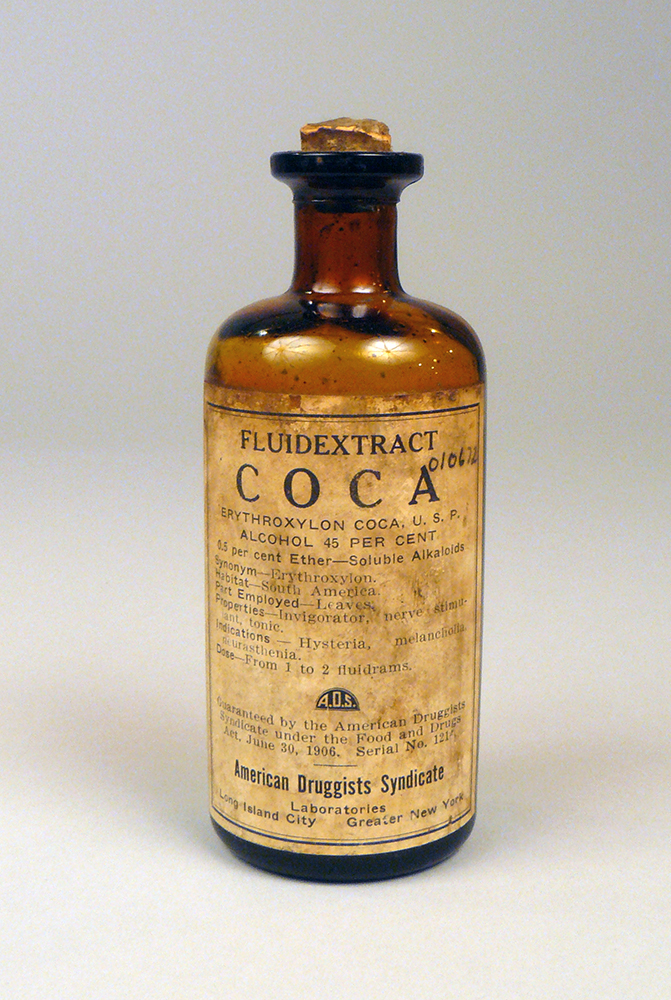
Cocaine is derived from
the coca plant native to the Andean highlands of South
America. Native Peruvians chewed coca leaves
only during religious ceremonies. This taboo was broken
when Spanish soldiers invaded Peru in 1532. Forced
Indian laborers in Spanish silver mines were kept
supplied with coca leaves because it made them easier to
control and exploit.
Pure cocaine was first isolated in the mid-nineteenth
century, but its effects weren't recognized in the
medical world until the 1880s. German chemist
Albert Nieman isolated cocaine from coca leaves in 1860.
He noticed that the powdery white substance made his
tongue feel numb.
In the 1880 it started to be popularized in the medical
community. Dr. Theodor Aschenbrandt, a German army physician, prescribed
cocaine to Bavarian soldiers during training to help
reduce fatigue. Austrian ophthalmologist Carl Koller
experimented with cocaine as a surgical anesthetic.
After soaking the eye in a cocaine solution, Koller
found that patients no longer flinched when the scalpel
touched their eye.
 Sigmund Freud, the Austrian neurologist who founded the
field of psychoanalysis, was fascinated with cocaine.
Early in his career, he began to experiment with the
drug. In In 1884, at the age of 28, Freud wrote a
paper titled “Uber Coca,” (About Coke) which he
described as a “song of praise to this magical
substance.” He overlooked a major downside to
cocaine: addiction. Freud struggled for the next 12
years to break his cocaine habit.
Sigmund Freud, the Austrian neurologist who founded the
field of psychoanalysis, was fascinated with cocaine.
Early in his career, he began to experiment with the
drug. In In 1884, at the age of 28, Freud wrote a
paper titled “Uber Coca,” (About Coke) which he
described as a “song of praise to this magical
substance.” He overlooked a major downside to
cocaine: addiction. Freud struggled for the next 12
years to break his cocaine habit.
Around the
same time,
French chemist
Angelo Mariani
concocted a
tonic made
from Bordeaux
wine and coca
leaves. He
called it Vin
Mariani.
Advertisements
claimed the
popular drink
could “restore
health and
vitality” and
lead to the
drug's
popularization
in Europe.
In 1886, Dr.
William Alexander Hammond, the
Surgeon-General of the U.S. Army
endorsed the medical use of
cocaine at a meeting of the New
York Neurological Society.
Throughout the early 1900s
unregulated medicinal "tonics"
were sold containing ingredients
including cocaine and opium.
Pharmaceutical companies soon
began marketing cocaine.
In 1886 "Doc" John Pemberton,
pharmacist, of Atlanta, Georgia
began to market "Coca-Cola," a
syrup derived from coca leaves and
African kola nuts. In 1899,
Coca-Cola began selling its
drink in bottles. Formerly a
wine drink for the middle-class,
everyone now had access to the
cocaine-infused sugar water.
The euphoric and energizing
effects on the consumer helped to
skyrocket the popularity of
Coca-Cola by the turn of the
century.
From the 1850s to the early 1900s,
cocaine and opium-laced elixirs
(magical or medicinal potions),
tonics and wines were broadly used
by people of all social classes.
Notable figures who promoted the
“miraculous” effects of cocaine
tonics and elixirs included
inventor Thomas Edison and actress
Sarah Bernhardt. The drug became
popular in the silent film
industry and the pro-cocaine
messages coming out of Hollywood
at that time influenced
millions. Even Sherlock
Holmes used cocaine.
Cocaine use in society increased
and the dangers of the drug
gradually became more evident.
Public pressure forced the
Coca-Cola co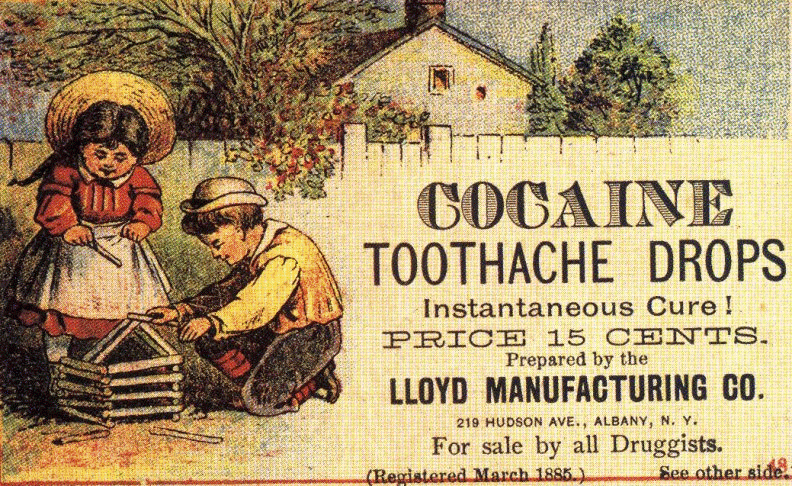 mpany to
remove the cocaine from the soft
drink in 1903. mpany to
remove the cocaine from the soft
drink in 1903.
Enthusiasm for anesthetic cocaine
quickly waned in the medical
community, however, as the number
of patients dying of accidental
overdoses during surgery
soared. By 1902 there were
an estimated 200,000 cocaine
addicts in the United States, By
1905, it had become popular to
snort cocaine and within five
years, hospitals and medical
literature had started reporting
cases of nasal damage resulting
from the use of this drug. In 1912, the United States government
reported 5,000 cocaine-related deaths in one
year. The Harrison Narcotics Act of 1914 was
one of the country’s first forays into
national drug legislation. The Act,
introduced by Representative Francis Burton
Harrison of New York, effectively outlawed
the sale and use of coca and opium products
and usage declined throughout the 1940s
through the 1960s. In the 1970s
cocaine regained popularity as a
recreational drug and was glamorized in the
U.S. popular media. Articles from the time
proclaimed cocaine as non-addictive. The
drug was viewed as harmless until the 1985
emergence of crack.
References
in the Play
The 10th
Ward:
Grand Street
between the
Bowery and
Allen Street
http://www.nysonglines.com/grand.htm
http://tenant.net/Community/LES/preface.html
Picture to the
right: Attic
rooms at
298-300 Grand
Street (just
west of Allen)
in 1932.
From the script: The action takes place in an attic
bed room on Grand Street, between Allen and the
Bowery, in the late summer of 1916, and occupies the
time between four o'clock a.m. and daylight.
The 10th Ward is
bounded on the east by Allen St., west by the Bowery,
Grand Street on the north and Division Street to the
south.
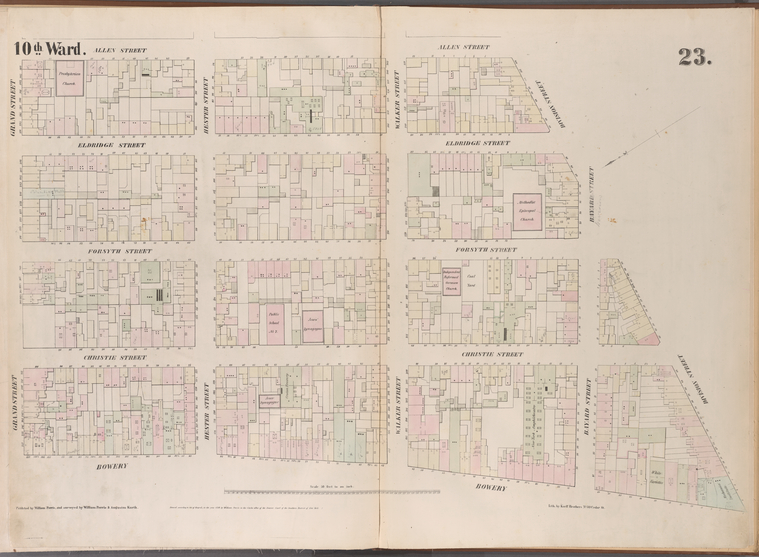
New York City was
divided into wards between 1683 and 1938. These were
used for the election of various municipal offices,
and would later be used to construct the boundaries of
larger electoral districts. Prior to the
formation of the so-called City of Greater New York in
1898, what is now New York City comprised multiple
municipalities that had different histories with wards.
The 10th Ward is the core of what we've come to think
of as the immigrant "lower east side." This ward
was reported to be the most densely populated place on
earth in 1900. According to a survey of New York's
tenement houses in that year, the tenth ward contained
1,179 tenement houses in 1900. These houses were home
to 15,132 families, comprising a population of 76,073.
The bulk of
immigrants who came to New York City in the late 19th
and early 20th centuries came to the Lower East Side,
moving into crowded tenements there. By the
1840s, large numbers of German immigrants settled in
the area, and a large part of it became known as
"Little Germany" or "Kleindeutschland". This was
followed by groups of Italians and Eastern European
Jews, as well as Greeks, Hungarians, Poles, Romanians,
Russians, Slovaks and Ukrainians, each of whom settled
in relatively homogeneous enclaves. By
1920, the Jewish neighborhood was one of the largest
of these ethnic groupings, with 400,000 people,
pushcart vendors prominent on Orchard and Grand
Streets, and numerous Yiddish theatres along Second
Avenue between Houston and 14th Streets.
By the turn of the twentieth century, the neighborhood
had become closely associated with radical politics,
such as anarchism, socialism and communism, and was
also known as a place where many popular performers
had grown up, such as the Marx Brothers, Eddie Cantor,
Al Jolson, George and Ira Gershwin, Jimmy Durante, and
Irving Berlin. Later, more radical artists such as the
Beat poets and writers were drawn to the neighborhood
– especially the parts which later became the East
Village – by the inexpensive housing and cheap food.
Founding editor of the Yiddish Forward, the newspaper
for the Jewish immigrants, Abraham Cahan observed the
prostitution in the area at the turn of the centruy:
The most
disgusting area of the city at the time was Allen
Street, which was precisely in the midst of the
Jewish neighborhood,” Cahan wrote in his memoirs in
1894. “At night in the disorderly houses the windows
were lit with red lamps — the source of the
expression ‘red light district’. Allen Street was
the center of the brothel district and owners of
these disorderly houses were known as ‘cadets’ or
‘alphonses,’ as one would call the revolting
creatures who live off the disrepute of the women
they enslave and whom they dominate with unlimited
power. It was literally dangerous to walk down those
streets.”
So little had changed by
the turn of the century that Cahan broadened his
admonition to Forward readers: “It is better to stay
away from Allen, Chrystie and Forsyth Streets, if you
go walking with your wife, daughter, or fiancee. There
is an official flesh trade in the Jewish quarter. In
the window you can see human flesh instead of shoes.”
The Elevated
From the script: NORA: The Elevated
sounds like wind. Like a spirit that can't
rest. The spirit of the city, that goes on and
on day and night and never stops and never
will stop, no matter what becomes of you and
me.
Pendleton would have been well aware of the disturbing
sounds of a passing elevated train. In 1916, he
was living at 85 Washington Square Place, which was
right next to the 6th Avenue El, though he elevated
train referred to in the play is the Third Avene El.
Enjoy the link below
for a ten-minute documentary on the "The Vanishing EL"
New York City's last Elevated train, including footage
that takes the El for a ride in the 1950s:
https://youtu.be/85SoH6cjiOc
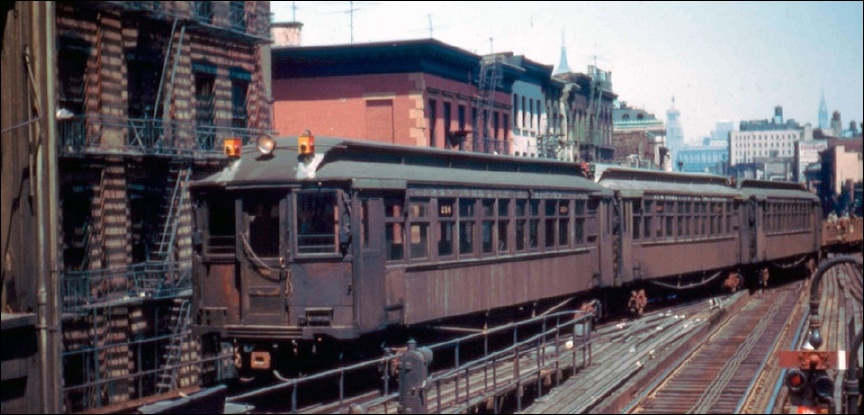
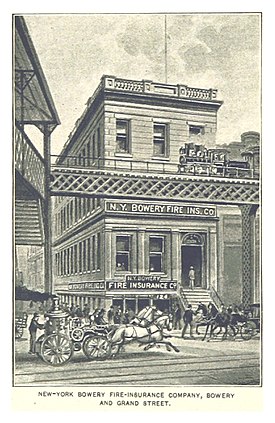
Below are pictures of the Grand Street Station, Joe
and Nora's station, at corner of Bowery and Grand
Street; the Elevated tracks along the Bowery and a
picture showing the proximity of train cars to bedroom
windows.
In 1917, as
the play was
being
performed, the
Bronx portion
of the Third
Avenue El was
being
completed and
connected
In 1875, the
Rapid Transit
Commission
granted the
New York
Elevated
Railway
Company the
right to
construct the
railway from
Battery Park
to the Harlem
River along
the Bowery and
Third
Avenue.
The Third
Avenue El
opened in
1878, running
from South
Ferry to 129th
Street.
The Manhattan
Railway
assumed
operations of
the Suburban
in 1891 as an
extension of
the Third
Avenue Line,
and through
service
between the
Bronx and
Manhattan
began in 1896.
For New York
City's
transportation
system, the
project was "a
more important
engineering
feat than the
building of
the Panama
Canal"
according to
the IRT.
The center
track of the
Bronx portion
opened on
January 17,
1916; in
Manhattan it
was opened on
July 9, 1917.
In the 1930s
and 1940s, as
part of the
integration of
the different
subway
companies in
New York
City—the IRT
along with
Brooklyn–Manhattan
Transit (BMT)
and
Independent
Subway System
(IND)—the
Third Avenue
elevated and
its
counterparts
on Second,
Sixth, and
Ninth Avenues
came under
criticism from
New York mayor
Fiorello La
Guardia and
his
successors.
The elevateds
were regarded
as blights on
their
communities
and obsolete,
since the
subways were
being built or
were planned
to replace
them.
All but the
Third Avenue
El were closed
and demolished
by 1942.
The Third
Avenue
elevated was
kept open
because it was
intended to
stay in use
until the
Second Avenue
Subway was
built to
replace
it. It
might still be
there, but for
the pressure
against the
elevated from
real estate
interests,
saying the
noise from the
elevated
"constitutes a
menace to
health,
comfort and
peaceable home
life." The
system was
closed in
sections from
1950 to 1973.
What causes
cold sores?
https://www.campho.com/what-causes-cold-sores/
https://www.medicalnewstoday.com/articles/camphor-oil
https://www.healthline.com/health/what-is-camphor#differences
From
the
script:
NORA:
... It's
that darn
fever blister.
If I had only
had sense
enough to get
some camphor
that first
day.
 Cold
sores, those
itching,
burning, often
painful
lesions that
appear on the
skin generally
around your
mouth. How did
you get them?
The cause of
cold sores is
relatively
consistent but
the triggers
and how each
of our bodies
deal with them
vary by
individual.
Since it is
estimated that
just under
half of people
in the US aged
14-49 have the
virus that
causes cold
sores, its
important to
understand the
potential
triggers and
treatment
option
availble to
those who
suffer. Cold
sores, those
itching,
burning, often
painful
lesions that
appear on the
skin generally
around your
mouth. How did
you get them?
The cause of
cold sores is
relatively
consistent but
the triggers
and how each
of our bodies
deal with them
vary by
individual.
Since it is
estimated that
just under
half of people
in the US aged
14-49 have the
virus that
causes cold
sores, its
important to
understand the
potential
triggers and
treatment
option
availble to
those who
suffer.
The source of
your cold sore
is most likely
something you
contracted a
while ago
which may not
have caused
any symptoms
at that time.
Most commonly,
cold sores are
a symptom of
the Herpes
Simplex Virus
Type 1 which
which is
transmitted by
close contact
(touching
& kissing)
and thrives in
mucosal
membranes.
After getting
your first
cold sore,
your body
produces
anti-bodies
and many
people will
never have
another
outbreak while
others will
get them
repeatedly.
You may not
suffer an
outbreak until
up to 20 days
of being
infected.
Nora refers to
Camphor as the
cure.
Indeed Camphor
seems good for
what ails
you. It
remains an
active
ingredient in
many
over-the-counter
cough and cold
remedies.
Camphor for
skin : Lotions
and creams
containing
camphor can be
used to
relieve skin
irritation and
itchiness and
may help to
improve the
overall
appearance of
skin. It has
antibacterial
and antifungal
properties
that make it
useful in
healing
infections.
- Relieves
pain: Applying
camphor to the
skin helps to
relieve pain
and
inflammation.
- Heals
burns
- Treats
arthritis:
Effective in
relieving
pain,
inflammation,
and swelling
due to
arthritis.
- Treats
toenail fungus
- Relieves
congestion and
coughing
- Antispasmodic:
Camphor
products may
also be used
as a muscle
rub. It may
help to
relieve muscle
cramps,
spasms, and
stiffness.
- And
everything
else, it
seems:
hair loss,
acne,warts,earaches,
hemorrhoids,
heart disease
symptoms,
poor blood
circulation,
flatulence,
anxiety,
depression, low
libido
- And
cold sores ...
Popular
current
products
containing
camphor
include:
- Tiger
Balm
- Vicks
VapoRub
- Bengay
- Icy
Hot
- Biofreeze
TA
https://english.stackexchange.com/questions/5567/where-does-ta-come-from
From the script: JOE: Gee!
Ta! NORA: Joe, I wish you wouldn't say "Ta." JOE:
... Common stuff, uhm?
Perhaps
Pendleton heard "Ta'" on the streets of London when he
attended Oxford. In 1916, it was associated
with English working class slang. We can hear it
in movies, out of the mouths of saucy Cockney
characters. It means "Thanks" as a completion of
a transaction, more than an expression of gratitude,
often used as Americans would use "See you
later." It is a familiar expression, very
widely in use in England today. What
is it doing here on the Bowery?
Pendleton uses it to draw a class distinction
between Nora and Joe, and also reveals, perhaps,
that Nora's attraction to the working-class Joe, a
former fighter, has an element of danger for her.
The Evening Sun
https://chroniclingamerica.loc.gov/lccn/sn83030272/
NORA:
[laughs] Nor a very fine kind of lady. I've told
you all about myself. I did work on the Evening
Sun, and before that I used to live on a farm in
Kentucky. That's all there is.
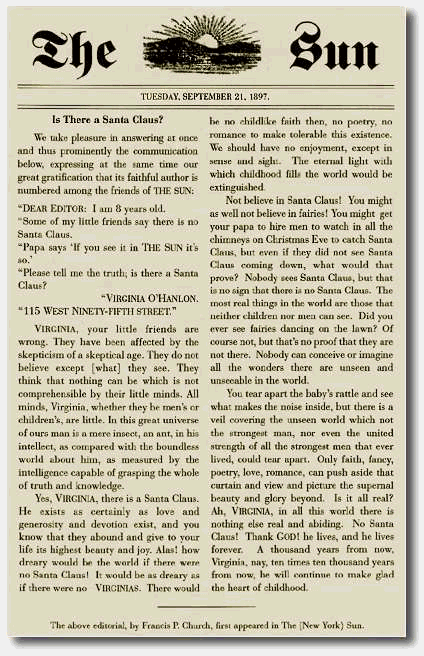 The
Evening Sun was the evening edition of The Sun, a
serious newspaper which featured the work of Bret
Harte and Henry James among other American literary
mainstays, suggesting Nora was no slouch. Frank
Simonds was editor of The Evening Sun (1913-14) and
then associate editor of The Tribune (1915-1918) the
newspaper for which Pendleton King had begun working
when he was drafted. Pendleton was of
course raised on a plantation in Georgia, not unlike
Nora on "a farm in Kentucky." The
Evening Sun was the evening edition of The Sun, a
serious newspaper which featured the work of Bret
Harte and Henry James among other American literary
mainstays, suggesting Nora was no slouch. Frank
Simonds was editor of The Evening Sun (1913-14) and
then associate editor of The Tribune (1915-1918) the
newspaper for which Pendleton King had begun working
when he was drafted. Pendleton was of
course raised on a plantation in Georgia, not unlike
Nora on "a farm in Kentucky."
The Evening Sun was bought out and merged in 1916,
about the time Cocaine was being prepared for
production. On September 21, 1897, in response to
a letter from eight-year-old reader Virginia O'Hanlon
(“Papa says ‘If you see it in The Sun it’s so.’ Please
tell me the truth, is there a Santa Claus?”), the
paper published “Yes, Virginia, there is a Santa
Claus.” This opinion piece by veteran newspaperman
Francis P. Church, insisting that Santa Claus “exists
as certainly as love and generosity and devotion
exist,” caused an immediate sensation. It became one
of the most famous editorials in newspaper publishing
history; the Sun would reprint this editorial annually
until 1949.
The New York Sun debuted on September 3, 1833,
becoming the first successful penny daily, popular
with the city’s less affluent, working classes. Its
publisher, Benjamin H. Day, emphasized local events,
police court reports, and sports in his four-page
morning newspaper. Advertisements, notably help-wanted
ads, were plentiful. By 1834, the Sun had the largest
circulation in the United States. Its rising
popularity was attributed to its readers’ passion for
the Sun's sensational and sometimes fabricated stories
and the paper’s exaggerated coverage of sundry
scandals. Its success was also the result of the
efforts of the city’s ubiquitous newsboys, who the
innovative Day had hired to hawk the paper. The Sun
added a Saturday edition in 1836. A number of
weekly and semiweekly titles were also published, such
as the Weekly Sun (1851-69), which shares the same
masthead as the Sun with "Weekly" appearing in the
title ornament.
The paper’s true glory days began in
1868 when Charles A. Dana, former managing editor of
the New York Tribune, became part owner and editor.
Dana endeavored to apply the art of literary
craftsmanship to the news. Under him, the Sun became
known as “the newspaperman’s newspaper,” featuring
editorials, society news, and human-interest stories.
A Sunday edition was added in 1875 and, later, a
Saturday supplement appeared, offering book notices,
essays, and fictional sketches by Bret Harte, Henry
James, and other well-known writers. In the 1880s, the
paper’s size increased to eight pages and in 1887 the
Evening Sun hit the streets in two editions: Wall
Street and Night
By 1910 the paper
averaged some 15 pages, with Sunday editions triple
that length. In 1916 entrepreneur Frank A. Munsey
purchased the Sun, and a series of mergers followed.
In July 1916, the Sun briefly became the "Sun and New
York Press" and then reverted to the Sun by the end of
the month. In 1920, the Sun merged with the New York
Herald, and the titles were combined to create the
"Sun and the New York Herald." In October 1920,
the daily was split into the "New York Herald" and
"the Sun," absorbing the "Evening Sun" in the
process. "The Sun" continued until January 5,
1950, when it merged with the "New York
World-Telegram" and became the "New York
World-Telegram and the Sun." In 1966 that title became
part of the "World Journal Tribune"; the latter folded
the following year.
"But now the
white sails of
our ship are
furled,
And spent the
lading of our
argosy."
https://poemanalysis.com/oscar-wilde/my-voice/
Nora quotes from Oscar Wilde,
indicated her erudition. "My Voice" from 1881. It is a
short poem that tells briefly of the pleasures of love
that were taken by the speaker and his female partner.
It moves quickly from pleasure, to the loss of that
love. The poem describes how because the love is gone,
the speaker’s cheek have become wan before his time, and
Ruin has come for him in his bed. My Voice ends with the
speaker mourning the fact that when his lover reminisces
on their love she will see and experience it only as a
subtle dream, easily put aside. This poem is the
companion piece to the longer, Her Voice. In which the
female partner tells why she felt their love had to end.
My
Voice
Oscar Wilde -
1854-1900
Within the
restless,
hurried,
modern world
We took our
hearts’ full
pleasure—You
and I,
And now the
white sails of
our ships are
furled,
And spent the
lading of our
argosy.
Wherefore my
cheeks before
their time are
wan,
For very
weeping is my
gladness fled,
Sorrow hath
paled my lip’s
vermilion
And Ruin draws
the curtains
of my bed.
But all this
crowded life
has been to
thee
No more than
lyre, or lute,
or subtle
spell
Of viols, or
the music of
the sea
That sleeps, a
mimic echo, in
the shell.
Prepayment Gas
Meters
The
Numismatic
Bibliomania
Society
coinbooks.org.
From
the script:
NORA: [sits up
in bed] The
meter? But it
can't have run
out. [A wave
of terror
comes over
her.] Have you
been using the
gas nights?

Prepaid meters for gas remain popular where there is a
likelihood
that the
tenant will
not pay the
bill, though
the use of
pre-purchased
tokens, or
swipe cards
are used in
place of
coins.
Coins would
very likely
have been in
use in the
rooming houses
in the sadder
sections of
New York City
at the time.
Prepayment Gas Meters were never as popular in the
United States
as in
England.
Below are some
comments on
the net about
the vagaries
of prepaid
meters, which
are much the
same a hundred
years since
the play was
written.
"I used to
have one of
these things
in my house
when stationed
in Scotland in
the late 70s.
It took 5
pence/shillings
and I forget
how much gas I
got from a
single coin.
This created a
big problem
during the
very cold
winter of
77-78, because
the coin box
was a finite
size and could
only hold so
many coins.
Between a
strike by the
British gas
workers and my
non-conventional
work hours,
the thing
never got
emptied. It
got to the
point where I
could not buy
any more gas
because the
mechanism was
jammed up.
Calls to the
gas company
were ignored.
The situation
was resolved
by an official
complaint
through the
base and
somebody
showed up by
appointment to
empty the
thing. The
coin box was
so full it
would not
slide out of
the housing
and the guy
ended up
bending it so
enough coins
could be
scraped out to
permit
removal. Since
he couldn’t
put the coin
box back in,
he made me
promise not to
take any coins
away after
putting them
in the
machine. I got
a whole new
meter in the
spring when
the strike was
over, and yes,
there was a
pile of coins
waiting for
them."
"I remember
one well, and
it was only 40
years ago.
While on
vacation in
Penzance
Cornwall in
1973, the flat
we rented had
one. It
accepted the
new 10P coins
or the old
Florins that
coexisted in
circulation. I
don't recall
how much time
you got for
your 10p or 2
bob, but it
was wise to
have a stack
of them handy
for fear of
running out in
the middle of
your cooked
dinner or
shower. To put
things in
perspective,
the farmers
market in town
charged 5p
(1/-) for a
head of
lettuce that
he went out
back to pull
out of the
garden. We pay
about $2.00
for a head of
lettuce today
making the few
minutes of gas
we bought
worth today
about $4.00"
"Gas and
electricity
meters were
quite common
in the UK when
I was a boy,
particularly,
as you say, in
multiply-occupied
premises. The
shilling was
the standard
coin used for
the purpose,
and I can
remember
visiting some
friends in the
mid-1960s to
find them
quite
concerned
about having
got two
shilling coins
wedged
alongside each
other in the
slot, thus
potentially
running them
out of power
without the
means of being
able, without
an engineer's
visit, to do
anything about
it."
"Some early
power meters
were not as
sophisticated
as current
slot machines
at being able
to detect
unauthorised
substitutes
for the
correct coin,
and I am told
that it was
possible to
freeze water
to the shape
of the
relevant coin
and use the
resulting
discs instead.
This had the
advantage that
the evidence
of the
misdemanour
evaporated,
and the
disadvantage
of rusting up
the machine.
The German two
pfennig was a
very useful
substitute for
the sixpence
at one time,
before
machines
became weight
sensitive, but
I am not sure
what foreign
coin was
usually
favoured in
lieu of the
shilling. My
father's uncle
{b.1902}
worked for
many years for
the Cardiff
Gas Company
and he once
said that they
had 500,000
cut down
British
halfpennies in
their vaults,
all mutilated
so as to
imitate
shillings,
which it was
not
economically
viable to
shift and
scrap. I once
heard on the
radio that the
one county of
Glamorgan
produced 45%
of all the
mutilated
currency of
the UK
{Cardiff being
its major
city}."
A
Final Thought
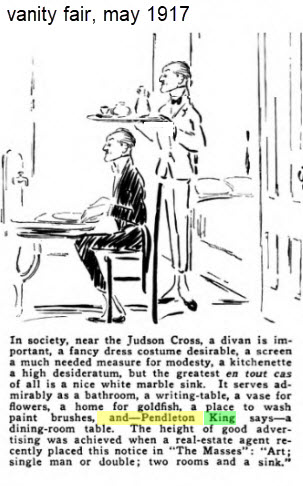
A cartoon in "Vanity Fair" marks the height of renown
which the 27
year old
writer was to
achieve.
After a season
of numerous
stage
appearances,
and the
enthusiastic
critical
reception of
his stark
play, Cocaine,
and the
beginning of a
journalism
career with
the New York
Tribune, Vanity
Fair
quotes
Pendleton King
as an arbiter
of bohemian
furnishings.
A rich Oxford
educated
Georgian
writes a play
about
prostitution,
drug addiction
and romantic
obsession that
takes place in
an attic
apartment on
the
Bowery?
There is much
more to the
story of this
incongruous
southern
gentleman.
To be
continued ...
|
|